A pedestrian signal on NE 125th Street does more than just stop traffic. It connects a neighborhood to its library, its bus stops, and its seasonal farmers’ market. For years, this busy street was a barrier; now, it’s a community connector.
This project is one of the standout successes of Seattle’s Neighborhood Street Fund (NSF), a program designed to build small-scale, high-impact projects proposed directly by the community. But how were these projects chosen, and how did the city balance community popularity with the urgent need for equity?
According to Madeline McCort, a Public Engagement Associate with the Seattle Department of Transportation (SDOT), the program’s inner workings were designed to do just that. The city’s approach reveals how the Emerald City is building a more equitable, resilient, and walkable future, one block at a time.
A common question about community-driven programs is whether they become a “popularity contest” favoring well-resourced neighborhoods. McCort explained that the NSF was built on a process to prevent this.
The “roadmap,” as she calls it, is the Transportation Equity Framework (TEF). This framework guided every stage of the program. While residents applied for and voted on projects, the final selection was not based on votes alone.
“Project ideas were selected in geographic equity areas based on the City’s Race and Social Equity Index, and Displacement Risk Index to further prioritize projects in areas of the city with the highest need,” McCort said. This data-driven approach ensured that projects were prioritized in historically underserved communities, many of which are most impacted by pollution and climate change due to their proximity to freeways and busy streets. “Our goal is to create a transparent, data-informed process where the community’s voice, guided by an equity lens, directs the funding,” she said.
Meaningful community engagement was another cornerstone of the program. McCort described it as creating “two-way conversations so that many different voices are reflected in all stages of our projects.”
Recognizing that traditional public meetings are a burden for many, SDOT used a mix of strategies to lower barriers to participation. This included:
- Partnering with community-based organizations that serve diverse residents.
- Attending existing neighborhood gatherings rather than asking people to come to them.
- Offering translated materials and interpretation at events.
- Providing multiple feedback channels, including online, by phone, paper surveys, and in-person.
While discussing how the NSF program encourages and prioritizes projects that also build climate resilience at a neighborhood level, this is what Ms. McCort had to say. “During the project selection process, we weighed votes for projects located in the highest equity areas of the city, many of which are most impacted by climate impacts and negative environmental factors due to proximity to freeways and busy streets, lack of greenspace, and lack of spaces to be active. Once projects are selected we also work to build in climate resilient features such as green stormwater infrastructure, for example, on the 55th Ave S Sidewalk.”
While many NSF projects involved concrete for sidewalks and crosswalks (chosen for its long-term durability), the program also worked to solve the “concrete jungle” dilemma.
“Where possible, we work to make the projects aesthetically pleasing and add greening,” McCort noted. She pointed to several examples:
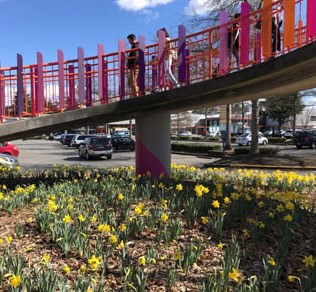
- Collaboration with Local Artists: Worked with an artist to add artwork to a pedestrian bridge for the Aurora Ave N Corridor Improvements.
- Art & Vibrancy: The 51st Ave S and Renton Ave S Traffic Safety Enhancements installed “blue wave” thermoplastic art in the curb bulbs.
- Urban Greening: The N 122nd St and N 128th St Walkway projects both added a planting strip with trees next to the new walkway.
This holistic approach ensured that a simple safety project could also build climate resilience and contribute to the neighborhood’s beauty and identity.
One of the program’s simplest measures of success, according to McCort, is “understanding how the community feels when the project is complete.”
The overwhelming positive feedback from the NE 125th St project, which solved a critical first-mile/last-mile problem by connecting people to transit, demonstrates the power of this community-led model.
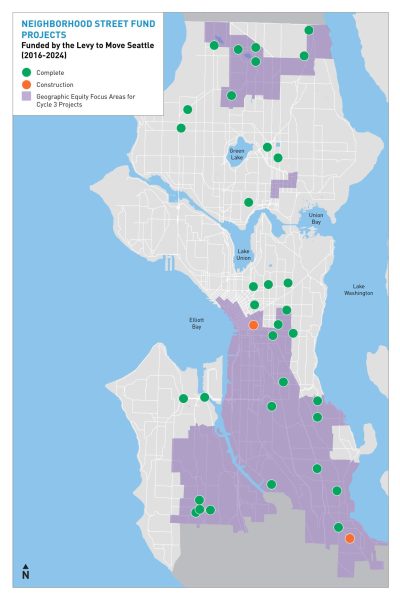
As the NSF program winds down after nine successful years funded by the 2015 Levy to Move Seattle, its core values of community engagement and data-driven equity are being carried forward. “The Neighborhood Street Fund (NSF) Program is closing out, but SDOT is working on launching a new program funded by the 2024 Seattle Transportation levy that will also be community-driven, called the Neighborhood Initiated Safety Partnerships Program.”
The story of the Neighborhood Street Fund, as told by both city officials and residents, is ultimately one of alignment. It’s a case where stated public policy and the daily experiences of residents converged for a positive outcome. The success of the various projects illustrates that balancing community input with a strong, data-driven equity lens can produce tangible, climate-resilient improvements that residents feel every day. his tested approach offers a working model for other local and campus-based initiatives, and proves that small, local projects are a powerful and essential tool in building a more connected and sustainable future for everyone.